Original source: https://www.bbc.co.uk/sport/rugby-union/58119049
Saturday, August 7, 2021
British and Irish Lions v South Africa has 'huge implications', says Ronan O'Gara
The British and Irish Lions' decisive third Test in South Africa "has huge implications for the future of rugby", says three-time tourist Ronan O'Gara.

The massive experience gap young Wallabies face against All Blacks as Auckland plans wild welcome
The Wallabies will be out to change 35 years of history at Eden Park on Saturday night in their Bledisloe Cup opener with the All Blacks. New Zealand, in contrast, will be celebrating it.
Aaron Smith will become just the tenth All Blacks player to notch 100 Tests when he runs out in Auckland.
Right alongside Smith will be captain Sam Whitelock, the only other current Kiwi centurion, just as he was 19 years ago.
The pair first met on the way to their first day of high school in Feilding, a town of 17,000 people set in the beautiful rolling hills of the Manawatu.
Sports opinion delivered daily
“I remember it really clearly,” Whitelock said.
“Walking across the school grounds and little short Maori boy with a big afro yelling out at me going, ‘Oh bro, are you coming here?’
“I was like, ‘I’m dressed in school uniform walking to the first day of school so it’s pretty obvious’.”
Halfback Smith, 35 centimetres shorter than the imposing Whitelock, would take two years longer than his school mate to represent the All Blacks.
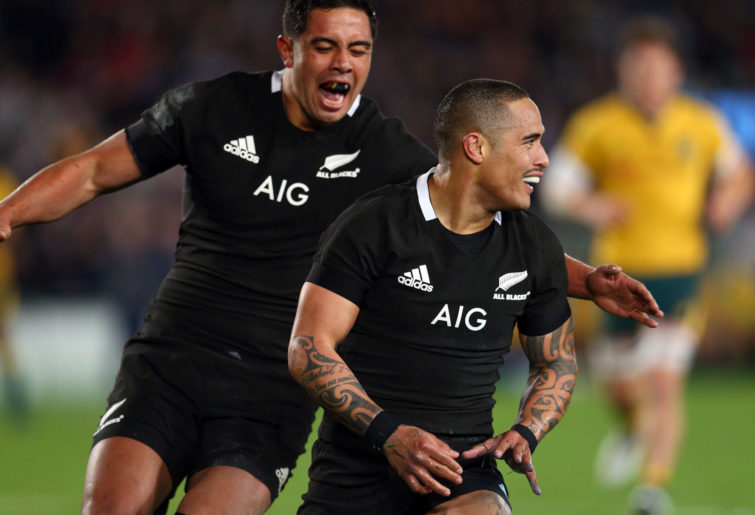
(Photo by Renee McKay/Getty Images)
“It’s pretty cool that we’ve both gone down different pathways, but we’re both here together,” Whitelock said.
“It’s pretty humbling for ourselves, but also the school and the community.
“People don’t see his hard work that goes on behind the scenes.
“He is the guy that’s always writing things down, putting a plan together and making sure that everything he’s doing is for the betterment of the team.”
Smith has played more than twice the number of Test matches than the entire Wallabies’ back line selected by Dave Rennie: just one of the reasons Australia will start as underdogs against the New Zealanders.
The other chief reason would be 35 years of hurt. Not since 1986 have the Wallabies beaten New Zealand at Eden Park, a run that has helped keep the coveted Bledisloe Cup in New Zealand since 2003.
One factor that could help Rennie’s side snap the streak is the weather. Australia secured a heart-stopping 16-16 draw with New Zealand on their first-up Test in New Zealand last year, achieved in ferocious winds and rain at Wellington’s Sky Stadium.
A gale force wind warning issued for Auckland on Saturday was not lost on All Blacks coach Ian Foster.
“(Australia are) a very committed physical ruck-and-run type team,” he said.
“They’ve spoken about dominating us up front and playing a fast physical game.
“The Wellington Test last year, my recollection was there was a lot of rain and wind and it was a very different game. The ball was swirling around.
“Hopefully we get a slightly different day here.”
Original source: https://www.theroar.com.au/2021/08/07/history-calls-for-wallabies-and-all-blacks/
Friday, August 6, 2021
Alun Wyn Jones wants less talk, more action
British and Irish Lions captain Alun Wyn Jones wants to maintain the tempo of the game and urged his players to engage less with under-prepared South Africa.
He will talk less to referee Mathieu Raynal and has urged his players to avoid scuffles with South Africa that will slow down the play in their series decider with the Springboks in Cape Town on Saturday.
Last weekend’s second Test lasted more than two hours with breaks in play due to confrontations among the players, injuries and Television Match Official referrals, which played into the hands of the Boks as they ran away comprehensive 27-9 winners.
With the home side’s preparations for the series having been severely disrupted by a COVID-19 outbreak in their squad that meant many of their leading players couldn’t train, the Lions should have the edge in fitness and the greater vigour for the closing stages of the game.
That is if they can avoid the multiple stoppages that allowed the Boks to catch their breath in the second Test.
“I won’t be talking to the referee unless I have to and they (scuffles) always happen but you don’t want to entertain them. It is not a case of taking a step back, but just an awareness of keeping the game flowing,” Jones told reporters.
“We want to maintain the tempo of the game. We should stay away from anything that might slow us down from getting to the next set.”
He conceded he was unsure if there will be more running rugby in the third Test after the first two encounters were dominated by kicking.
“It has the potential to be that way, sometimes finals can be attritional, but they can open up as well. I would like to think we are prepared for both. We don’t want to stifle ourselves with too much reliance on the kicking game,” Jones said.
“It’s a balance and that’s something that we probably didn’t have last week in the second half. We have to have the ability to play both ways and be ready for both (from the Boks).”
As for where the Lions need to improve for the decider, Jones is clear in his mind.
“Simplicity, discipline and accuracy…and to display the energy that we have shown throughout the tour,” he said.
Original source: https://www.theroar.com.au/2021/08/06/alun-wyn-jones-wants-less-talk-more-action/
https://blog.therugbystore.com.au/alun-wyn-jones-wants-less-talk-more-action/
British and Irish Lions: Ken Owens proud of first start in South Africa series decider
Wales hooker Ken Owens will finally make his first British and Irish Lions Test start on Saturday in the series decider against South Africa in Cape Town.
Original source: https://www.bbc.co.uk/sport/rugby-union/58099716
Thursday, August 5, 2021
Bledisloe teams named: Mo’unga given No.10 jersey, McKenzie stays at 15 for All Blacks
New Zealand have opted for Richie Mo’unga at No.10 over Beauden Barrett as they named their team for the opening Bledisloe Cup match against Australia on Saturday.
Mo’unga started at No.10 for the first Test of the campaign against Tonga before Barrett replaced him for the first of two Tests against Fiji. Mo’unga got the job again for the second Test and has retained it for this match.
The starting front row remains intact from the most recent Test with loosehead prop George Bower, hooker Codie Taylor and tighthead Nepo Laulala first choice ahead of props Karl Tu’inukuafe and Angus Ta’avao, and hooker Dane Coles.
Brodie Retallick returns to start alongside Samuel Whitelock at lock.
Ardie Savea has been named at No.8, Dalton Papalii at No.7 and Akira Ioane at No.6 with Luke Jacobson providing loose forward cover.
David Havili and Anton Lienert-Brown combine in the centres with Rieko Ioane moving to the left wing, Sevu Reece to right and Damian McKenzie at fullback, with Jordie Barrett and brother Beauden among those on the bench.
Bledisloe One team sheet ????#BledisloeCup pic.twitter.com/DlK34NfOEy
— All Blacks (@AllBlacks) August 4, 2021
All Blacks coach Ian Foster said props Joe Moody and Ofa Tuungafasi weren’t considered for selection as they return from injuries, while the selectors will ease back Will Jordan after a hamstring strain.
“There is huge excitement in our group at what lies ahead this weekend,” Foster said.
“There is such a huge history with the Bledisloe Cup, the rivalry between the All Blacks and Australia goes back a long, long way, and it’s always a massive contest. The Cup isn’t ours; we have to go out and win it again. We can’t wait for the weekend.”
The Wallabies are set to name their team at 2.30am AEST, after delaying the announcement from 10.30am. Missing will be winger Marika Korobiete, one of three members of the squad stood down for drinking beyond curfew last weekend.
All Blacks centre Anton Lienert-Brown said he expected Australia to be feeling strong after beating France in their recent series.
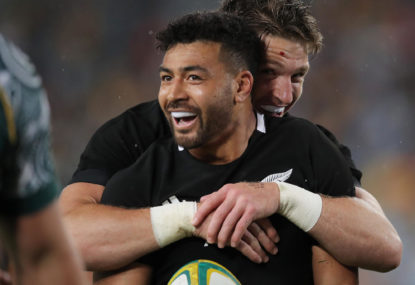
(Photo by Matt King/Getty Images)
“They will be confident,” he told stuff.nz. “They won the series and played pretty well. We know they are going to be physical and they are going to want to outwork us.
“There are not a lot of things that are going to surprise us but we know they are going to be up for this game and we have got to match them physically.”
The All Blacks were less troubled in beating a weakened Tonga and Fiji twice, than Australia were in the French battle.
“They have played in close matches and the three games we played were not as close. But we have got a lot of experience in this group, and a lot of boys who have played big games and that all counts as well.”
The All Blacks are smarting from their 2020 campaign, where they only won half of their matches.
“Last year for us was not good enough,” he said. “It is not the All Blacks standards, so we want to be better and we are driven to be better. This is a massive challenge for us to start in the right way.”
Eden Park will host the opening two Tests over the next two weekends, with a change in dates due to COVID restrictions. Sky Stadium in Wellington was due to host the third Test on August 28.
The third match will now be played at Optus Stadium in Perth on that date, a week lagter than first scheduled.
All Blacks scrumhalf Aaron Smith will play his 100th Test on Saturday and said the back-to-back games at the team’s fortress, where they haven’t lost to the Wallabies since 1986 or anyone since 1994, was something they had to take advantage of.
“I’ve never had it before. We’ve got to make the most of that opportunity,” Smith told reporters.
“That puts things in our favour very well.
“But the way the Australians are playing, the way I know Dave Rennie coaches, they’re not going to worry about that. It’s a big opportunity for them to make a statement.
“Eden Park doesn’t make you play any better, but knowing that the stadium is full, knowing the history of that field, knowing the standards that Eden Park demands … it’s good pressure.”
Smith said the All Blacks were in tune after the Pasifika series
“We put in lot of hard work, built some great connections, and started building some things around our game,” Smith said.
“We got a really good test from Fiji physically which was great. It’s something we’re going to need going forward.
“We’ve had that break at home, and come in refreshed for a big couple of months. It’s still unknown how that all looks but we know we’ve got two weeks of Bledisloe rugby, and that’s bloody exciting.
“We love that cup. It’s no one’s at the moment, and we’ve got to go out and earn it. You can really tell in our preparation it’s in the back of everyone’s minds. You know it’s a big game when it’s sitting there and bubbling away.
“I love that feeling. I love getting ready for a big game, and there’s been a real edge around the boys knowing there’s a big one coming.”
Foster praised Smith ahead of his milestone appearance.
“He’s a special man, he’s achieved so much in the black jersey and has been an iconic player for us over the last decade,” Foster said. “We know it’ll be a special night for him, his wife Teagan and his family.”
All Blacks team (Tests)
1. George Bower (3)
2. Codie Taylor (58)
3. Nepo Laulala (31)
4. Brodie Retallick (83)
5. Samuel Whitelock (125) – captain
6. Akira Ioane (4)
7. Dalton Papalii (5)
8. Ardie Savea (50)
9. Aaron Smith (99)
10. Richie Mo’unga (24)
11. Rieko Ioane (37)
12. David Havili (5)
13. Anton Lienert-Brown (50)
14. Sevu Reece (10)
15. Damian McKenzie (30)
Reserves:
16. Dane Coles (76)
17. Karl Tu’inukuafe (18)
18. Angus Ta’avao (16)
19. Scott Barrett (42)
20. Luke Jacobson (5)
21. Brad Weber (9)
22. Beauden Barrett (91)
23. Jordie Barrett (25)
Original source: https://www.theroar.com.au/2021/08/05/bledisloe-teams-named-mounga-given-no-10-jersey-mckenzie-stays-at-15-for-all-blacks/
Australia trio dropped from New Zealand opener after curfew breach
Australia drop Marika Koroibete, Isi Naisarani and prop Pone Fa'amausili for Saturday's match against New after breaking a team curfew with a drinking session.
Original source: https://www.bbc.co.uk/sport/rugby-union/58086862
https://therugbystore.com.au/australia-trio-dropped-from-new-zealand-opener-after-curfew-breach/
Wednesday, August 4, 2021
How Rassie Erasmus (over)ruled World Rugby in the second Test
If it had been a boxing contest, it would have been stopped to prevent further punishment. The triumph of the South Africa director of rugby Rassie Erasmus was not only over the British and Irish Lions, but over World Rugby in the build-up to the second Test at Cape Town.
There is no other governing body in professional sport which would have given Erasmus such license to criticise its officials and not issue immediate sanction.
Rassie has swapped roles effortlessly, from director of rugby, to water-boy, to social media influencer.
By the end of the game, the shape-shifting was complete. He was orchestrating the officiating crew from the sideline as expertly as Nigel Owens used to do in his pomp from the middle of the pitch. The broad grin on his face told you everything you needed to know.
Erasmus broke one of rugby’s great unwritten rules by criticising referee Nic Berry publicly, in the aftermath the first Test. At a deeper level, he was also undermining the vision of the game World Rugby set out in their 2020 law amendments.
International teams are afforded the right to discuss law interpretations both before and after a game is played. The understanding is that the fruits of those meetings remain private and the topics under discussion are not aired in the public domain.
Coaches in football are penalised severely for issuing opinions on the performance of the referee, even in short media interviews after the event. To the best of my knowledge, no football coach has yet taken to social media to deliver a 62-minute video critique of alleged officiating errors.
The sanctions are strict if a coach steps out of line. Back in 2016, the executive chairman of the English Premier League, Richard Scudamore, made the situation crystal clear:
“Premier League football and English football is known at home and abroad for being competitive and compelling, but also played in the right spirit.
“We and our clubs have been discussing concerns that certain elements of player behaviour are overstepping the mark – the mass confrontations, overt displays of dissent and offensive language. We are viewed by millions week in week out – including lots of young people – and it is our collective position that these types of behaviour should no longer be tolerated.
“That is why the Premier League, EFL and FA have tasked the Professional Game Match Officials with confronting these types of incidents and issuing appropriate sanctions in the form of cautions and sending-offs.
“Things happen in the heat of the moment during fast and highly competitive football; we still want to see the passion fans enjoy and demand, but players and managers have to be aware there are lines that should not be crossed.
“That is why we are working together with our EFL and FA colleagues to promote positive behaviour from all participants in the game.
“This shift in emphasis will involve PGMO referees responding more directly to these incidents and we will be communicating this to our managers, players and fans over the summer, ahead of what we hope will be another fantastic season of football.”
Two years later, match officials were given the right to issue red and yellow cards to managers and their support staff on the sidelines. Items on their menu included inappropriate language or gestures towards officials, the kicking of throwing water bottles, sarcastic clapping, the waving of imaginary cards and outright dissent.
Rugby’s proud tradition of respect for referees has been undermined by Erasmus’ recent outburst. He has opened Pandora’s box and in the process, he proposed a different model of the game to that envisaged by World Rugby in its 2020 law changes.
Key to those changes were two elements: a reduction of tackle height to the waist in order to prevent head injuries, with harsher sanctions for high tackles; and law amendments at the tackle area designed to produce cleaner, quicker ball for both sides at the ruck.
In a 62-minute outburst, Erasmus achieved the head coach’s dream. He got the law-makers and its officials playing by his rules, or the rules that suit his team the best.
The referee from New Zealand, Ben O’Keefe, unwittingly followed Rassie’s instruction manual to the letter. He shunned the Lions’ captain, Alun Wyn Jones, who had been so influential in the first Test, and he awarded 31 penalties.
Sports opinion delivered daily
There were a colossal 35 minutes of stoppage play buried within the 80 minutes the game was supposed to last, and a combined total of 81 kicks out of hand (including kick-offs and drop-outs) by both sides. Fifteen of those kicks were launched in the opposition’s half of the field.
There was little sustained, skilful attacking play with ball in hand by either team, so fearful were they of losing the ball in the wrong areas of the field. It was just as well there was nobody in Cape Town Stadium able to watch it all unfold.
This is emphatically not what World Rugby had in mind when it issued its new law guidelines in 2020. Now it has to take a stand and defend the vision of the game they embody.
There is ample material for Warren Gatland and his analytical team to present to the referee, Frenchman Matthieu Raynal, in the build-up to the third and decisive Test at the same venue next weekend, and right the wrongs of the week before.
In the interests of fairness and balance, chief among the issues will be South Africa’s attitude to the tackle and the play immediately following it. The Springboks want to get as much pressure on the receiver of a kick, or a ball-carrier as possible.
This means they make a lot of mistakes in the high kick chase, frequently taking out the ball-carrier in the air.
That is right wing Cheslin Kolbe taking out Lions fullback Stuart Hogg in the air early in the first Test. The pattern was repeated at the beginning of the second game, on this occasion with South Africa’s left wing Makazole Mapimpi chasing on to Dan Biggar.
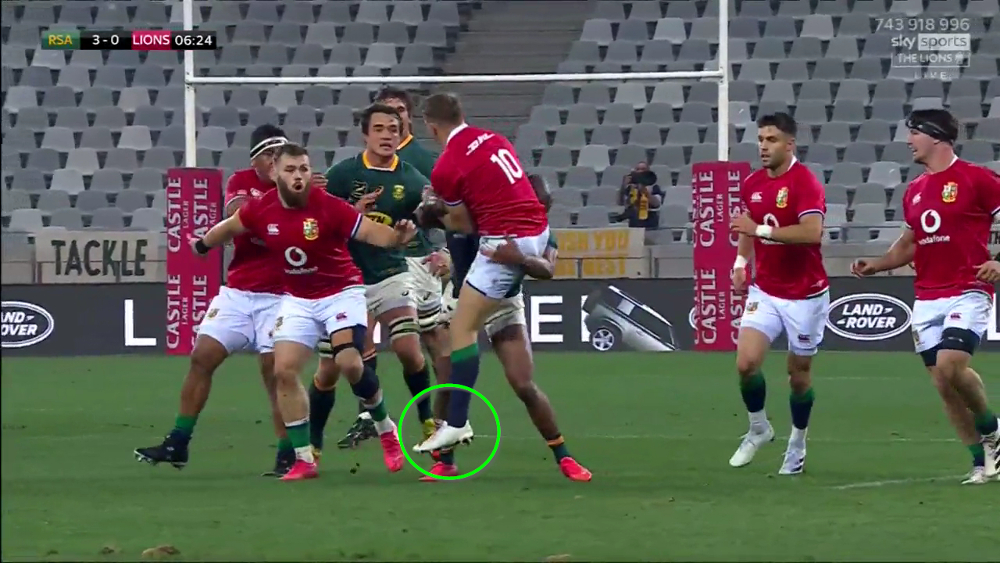
It was only a matter of time before a more serious incident occurred.
Kolbe again runs straight through the space underneath the receiver (Lions halfback Conor Murray) and that creates a dangerous situation. O’Keefe’s officiating crew decided the offence was only worthy of a yellow card, not a straight red.
In the action of making a tackle, South Africa’s players habitually do not follow World Rugby’s 2020 guideline about reducing tackle height to waist level – “Rationale: Forcing players to tackle lower may reduce the risk of head injuries to both the tackler and tackled player. It may also encourage more offloads and expansive play.”
Early in the first Test, Lukhanyo Am tackled his opposite number Elliot Daly.
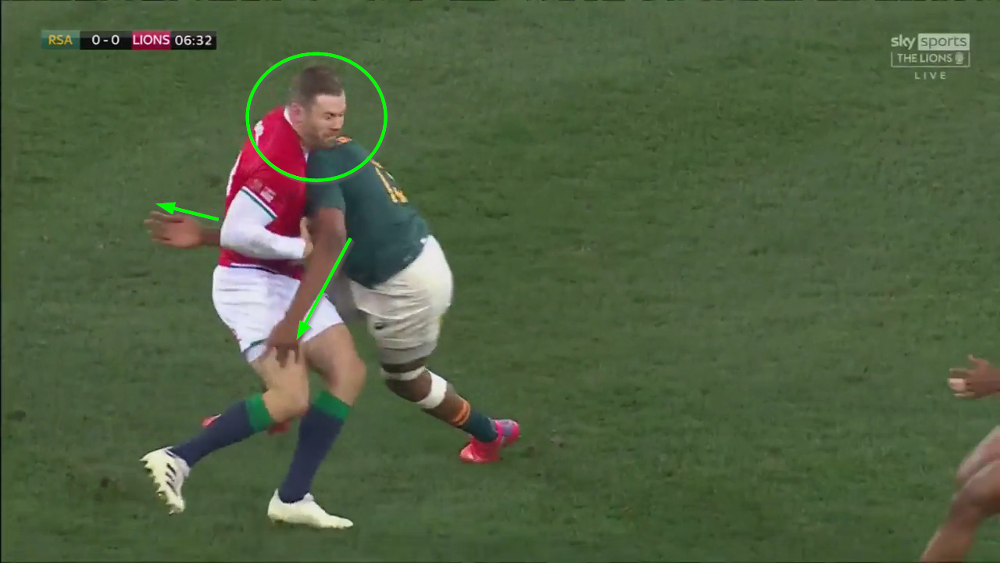
As the hit is delivered, the defender’s body is upright, with the left shoulder very close to the ball-carrier’s head and neck. The wrap with the arms is strictly token in nature.
A similar scenario led to a nasty clash of heads between Kolbe and Lions flanker Tom Curry early in the second game.
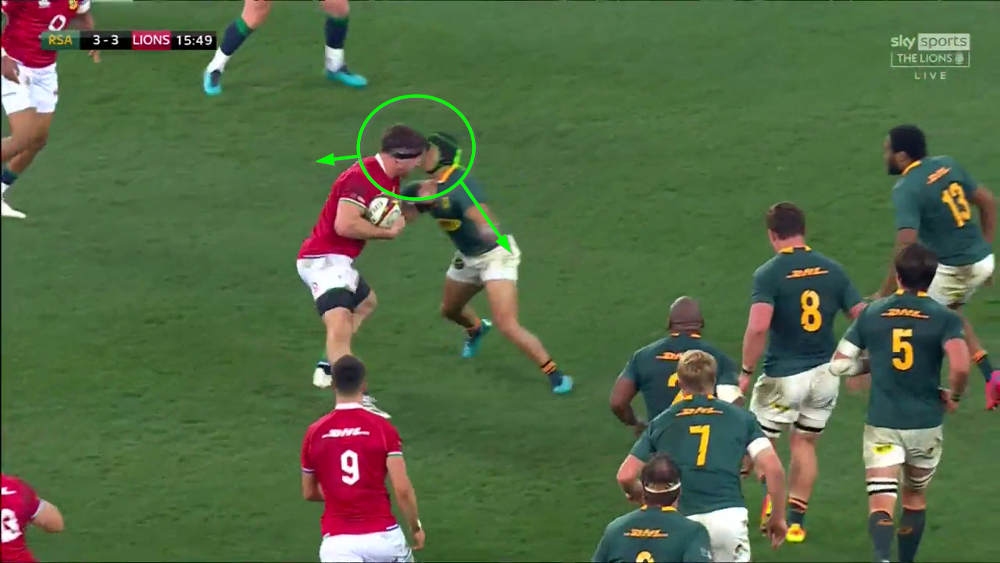
As Nigel Owens pointed out in the Sky TV commentary, “it’s head-on-head. You go in high like that, you’re in trouble… That is what you want to stop – you want to stop the head contact.”
There is no attempt made by the tackler to bend at the hips and therefore, head contact is inevitable. The incident crystallises a serious player welfare issue.
The serial offender from a Lions’ viewpoint would be Faf de Klerk. Warren Gatland rightly drew attention to De Klerk’s illegal challenge on Josh Navidi during the South Africa ‘A’ game:
There is no lowering of body height, and no wrap with the arms, as the scrumhalf tackles Navidi with his head.
There were two further examples from the second Test.
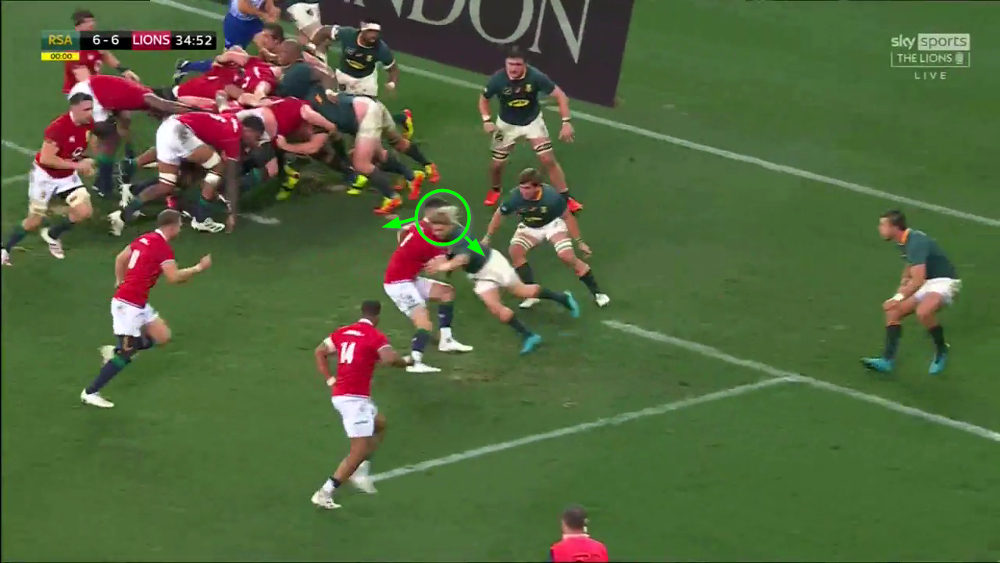
De Klerk’s head is at the same level as Murray’s when contact occurs and there is no serious attempt to wrap with the arms. The review of this incident by the officiating crew could be (politely) described as cursory.
In the second half, De Klerk then launched himself like a missile at Lions’ left wing Duhan van der Merwe.
The stream of high challenges was one reason for the mountain of stoppage time during the game. The last one occurred only five minutes from the end.
At least Franco Mostert tries to bend at the hips as he homes in on Owen Farrell, but he is still looking away from the target as his left shoulder flirts with Farrell’s head and neck.
The assault on World Rugby’s law amendments was intensified further at the post-tackle. The cardinal point is as follows: “Tackler (Law 14): 14.5 – must a) Immediately release the ball and the ball-carrier after both players go to ground and b) Immediately move away from the tackled player and from the ball or get up.”
It was here that the habits O’Keefe has picked up in Super Rugby Trans-Tasman really benefited the Boks.
There is no release by Makazole Mapimpi after he makes the tackle on Biggar. It was a repeated theme.
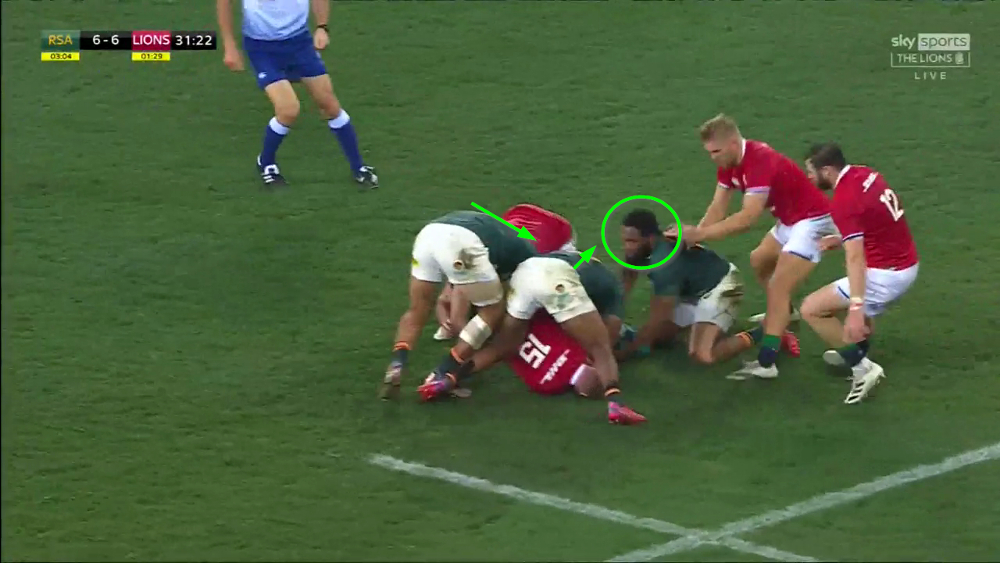
This situation would be familiar to followers of Trans-Tasman. The assist tackler (Mapimpi) never obviously releases the ball-carrier and the primary tackler sits directly in the path of the cleanout by the Lions’ support players.
The major plank in South Africa’s defence after a tackle is made is ‘no clear release’.
Most of the refereeing latitude was directed towards the defender, not the attacking side.
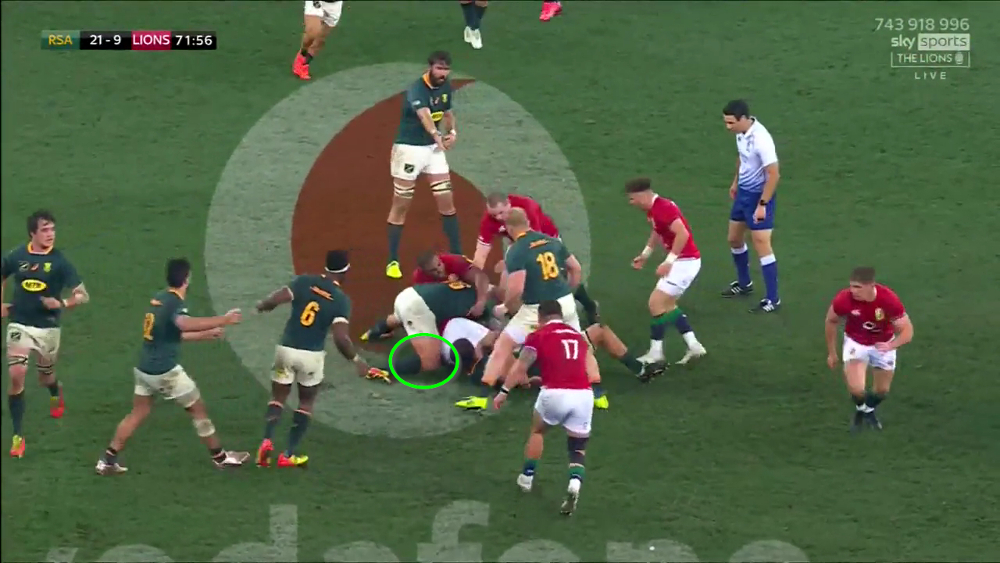
Malcolm Marx has clearly dropped one knee on to the ground in order to avoid the cleanout, but is nonetheless allowed to get back on his feet again and steal the ball.
Summary
New Zealand and Australia have always played the most constructive football of the professional era and been at the forefront of law changes that favour attacking play. It is time for them to do so again, and insist that the 2020 law amendments regarding tackling technique, and the production of quick ball at the breakdown are respected.
They would receive the support of the English Premiership clubs and referees, and that of the big European luminaries like Leinster and Toulouse. They are all headed in the same direction.
Rassie Erasmus won his battle with both the British and Irish Lions and, more importantly, World Rugby last week. His social media rant went unchallenged and that passed all the pressure back on to the officials for the second Test. They responded with a glut of penalties, yellow cards and stoppages in play.
More importantly, Rassie’s Springboks have thrown down the gauntlet to World Rugby in relation to their guidelines about high or dangerous tackle techniques, and release of the tackled player after a tackle is completed.
It is up to rugby’s governing body to screw its courage to the sticking place, and insist its officials implement its vision of the game for the future now. The current series does not provide a realistic model for either player welfare, or the good of the game as a whole.
Rassie won the battle, but he must not win the war.
Original source: https://www.theroar.com.au/2021/08/04/how-rassie-erasmus-overruled-world-rugby-in-the-second-test/
https://therugbystore.com.au/how-rassie-erasmus-overruled-world-rugby-in-the-second-test/
Subscribe to:
Comments (Atom)