Original source: https://www.bbc.co.uk/sport/rugby-union/58073124
https://therugbystore.com.au/british-and-irish-lions-warren-gatland-wants-quicker-third-test/
Original source: https://www.bbc.co.uk/sport/rugby-union/58073124
https://therugbystore.com.au/british-and-irish-lions-warren-gatland-wants-quicker-third-test/
Original source: https://www.bbc.co.uk/sport/rugby-union/58064491
Well, the Wallabies are in New Zealand ahead of the first Bledisloe Cup Test, and I must say, it’s a bit surprising we still don’t know where the second match will be played yet.
Of course, there’s good reason for that, and one of very many would be that the Nine Network in Australia is working feverishly with the NRL and several state governments around plans and possibilities and numerous contingencies around how to keep rugby league being played in a rapidly-changing COVID situation in Sydney and Brisbane.
Games being played in other sports, even games little more than a week away, would be down the priority list at the moment, and that would make things difficult for Rugby Australia to gain the clarity they would most certainly need for the rest of the series and The Rugby Championship beyond.
Hopefully, the next week questions are answered soon enough.
This week, on the other hand, raises different kinds of questions that can only be answered on the field with the first match of the series now just days away.
What is the back row strategy?
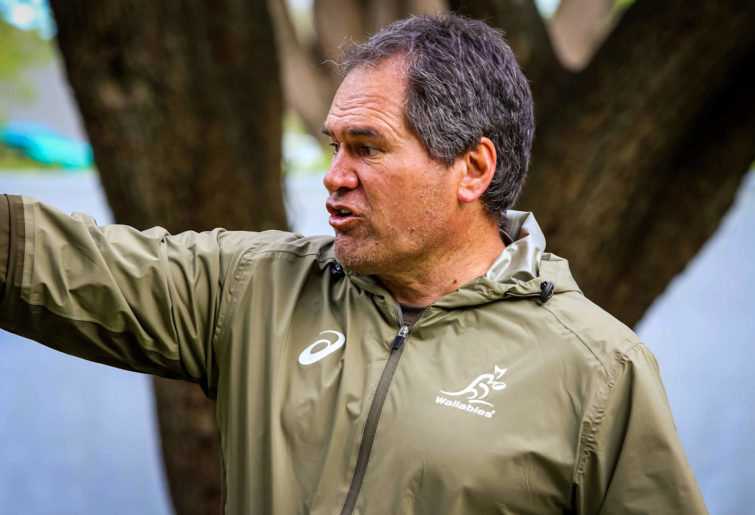
The team being named later in the week will partly answer this one, but it will be interesting to see which approach Dave Rennie takes into the first Bledisloe on Saturday.
(Andrew Phan/supplied by Rugby Australia)
The Rob Valetini-Michael Hooper-Harry Wilson unit were generally effective in the first two Tests against France, even if by the second game Les Bleus finished well on top of the breakdown ledger. But the unit didn’t survive intact for the third game.
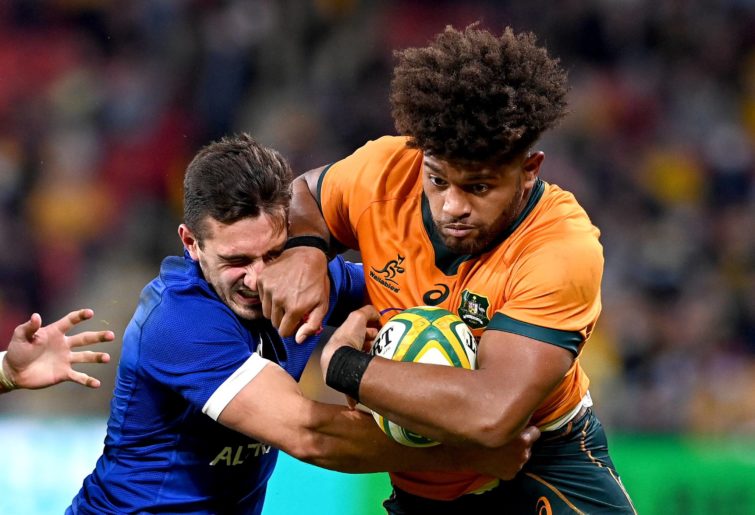
For the third game, Rennie promoted Isi Naisarani from the bench into number eight, left Wilson out completely and then pushed Valetini back to the bench to bring Lachie Swinton in.
It was a clear shift in approach. Valetini’s heavy physicality and Wilson’s wide channel speed was swapped out for Naisarani’s centre corridor presence and Swinton’s work rate, and though it felt a bit curious at the time, the two combined surprisingly effectively with Michael Hooper’s typically productive game.
(Photo by Bradley Kanaris/Getty Images)
A surprising combination in the same way Hooper ‘just worked’ when buddied up with Scott Fardy and David Pocock back in the day.
My strong suspicion is that that third France Test trio will be favoured again, if for no other reason than to lay a physical benchmark for the rest of the series. The Wallabies learned the hard way in Melbourne the folly of playing wide before going forward, and repeating that mistake against New Zealand at Eden Park is a recipe for disaster.
When to bring Taniela Tupou on?
The third match against France seemed to confirm – for now at least – that Taniela Tupou is best suited to coming off the bench for maximum impact, and that Allan Ala’alatoa is very much your starting benchmark setter.
Certainly, Ala’alatoa doesn’t offer anything of the bench impact that Tupou does; he just isn’t wired that way.
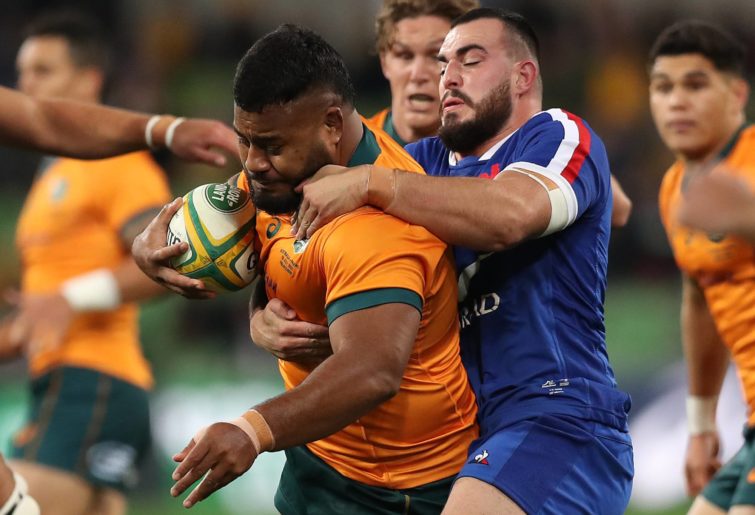
But Tupou is, though curiously his numbers from the last two Tests against France are surprisingly comparable from an output point of view. Starting the Second Test and coming off the bench in the Third, Tupou’s minutes-per-carry are remarkably similar. He didn’t make a tackle in the decider, but you’ll recall the Wallabies enjoyed pretty much exclusive possession in the last half an hour.
Getty Images
The difference, of course, is the quality of his involvements and the physicality he imparts on a game. Against tiring forwards nearing the hour mark of a game, the force of a 140kg monster is huge. Ala’alatoa just can’t do that.
So if it’s clear that Ala’alatoa starts, the question then becomes the timeframe in introducing Tupou to the contest.
There’s a train of thought that bringing him on before halftime allows Dave Rennie the chance to double-dip – five or ten minutes of impact before the break, reload and go again for another forty.
I’m not sure that works against New Zealand, though. The All Blacks will know Tupou’s first-contact tackle isn’t always great, and they’ll work him over to blunt his energy level and dampen his impact.
Again, we’ll find this out soon enough, but I suspect the final half-hour will remain the plan for now.
The scrumhalf conundrum
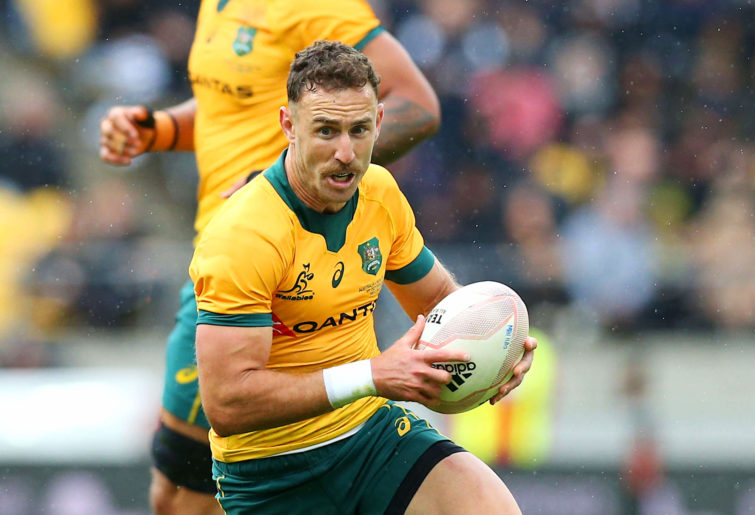
It’s one thing to bring Nic White back into camp because you expect him to be right for the back half of The Rugby Championship, and state lockdowns would prevent a timely late arrival, but is there a chance he could actually be right for this weekend?
He was hopeful rather than confident at a Canberra Stadium announcement back during the France series, but there’s genuine confidence to his tone now: “I’m back training now so fingers crossed I’m able to contribute in some capacity over the next couple of weeks,” he said before the Wallabies left Australia last week.
Certainly, he’s one of those guys who you pick if fit. The underlying question, however, is how fit is fit enough?
(Photo by Hagen Hopkins/Getty Images)
To kick for line or not at all?
Is there enough confidence in the lineout set-piece to remove the threat of backfield All Black counter by simply putting the ball into row B at every opportunity?
Obviously, it held up pretty well against France, but French experience levels may have been a bigger factor in that, given the abundant French talent on show.
But this might yet be the biggest sign of Dan McKellar’s input into the Wallabies coaching set-up. And suddenly, if the Wallabies are more confident about taking on the likes of Sam Whitelock and Brodie Retallick than giving the broken field ball to the All Blacks’ back three, then that really will be a significant step forward.
Are the outsiders about a bigger plan?
This is more around Duncan Paia’aua than Quade Cooper, I’ll admit, but both are certainly curious inclusions in this current Wallabies squad; Paia’aua as a selected squad member, Cooper as an intriguing consultant-type mentor who can still drill blokes 30 metres away while on the run.
What is Dave Rennie really playing at here? Is it a very strong enticement campaign, hoping to get Paia’aua back into one of the Super Rugby sides? Is it the first sign of a weakening of the previously firm stance on overseas-based players? Is it somehow COVID-forced to overcome a lack of available options left in Australia?
And is Paia’aua really in the frame to play this weekend or next?
Again, we’ll find this answer and all the others later in the week.
Original source: https://www.theroar.com.au/2021/08/03/bledisloe-dawn-the-questions-for-the-wallabies-ahead-of-game-1/
https://therugbystore.com.au/bledisloe-dawn-the-questions-for-the-wallabies-ahead-of-game-1/
When all of the nonsense associated with this Lions versus South Africa series is stripped away – and that will take some doing – what will be left is a measure of both sides against rugby’s base elements.
Who won the contest for possession, who won the contest at the gain line, who limited their errors, who took opportunities to convert field position into points?
The first 120 minutes of the series delivered near to a stalemate. But Saturday’s second half, a 21-0 whitewash, accurately reflected the Springboks’ dominance in all of those key aspects, and in the process, has shifted all of the pressure back to Warren Gatland and the Lions to find a way to eke out a series victory next weekend.
To say that there has been little expressive, open rugby played is to state the obvious, however this is a series dominated by exceedingly well organised defensive lines, compressing and squeezing space from the field, while executing with ruthless precision on the tackle.
Both groups may have parked their attacking ambition, but frankly, is it any wonder when space on the field has been harder to find than an Australian state premier who gives a fig about the national interest?
What little backline play that has been seen, has been marked by both sides being forced across the field; a natural reaction to the wall of steel in front of them, but on such an angle to render the tactic useless.
Multiple phase play, with players in motion off quick ruck ball has been absent. Not because the referees have failed to ensure a clean breakdown, but because of the assertive quality of the tackling, and the speed at which both sides have blocked off both sides of the ruck.
It was as if a switch had been flicked after halftime, the Springbok scrum at first edging into superiority, then the second front-row unit going right on with the job, denying the Lions a stable platform, then winning the penalties that ensured the territory stats were swung right around.
But it was their lineout maul that provided the vital incision, a massive, twisting and rolling effort in the 60th minute opening a window for Faf de Klerk to nudge into the in-goal for Lukhano Am to score.
A tenuous 11-9 score-line suddenly became 18-9 and it was evident, even that far out, that there wasn’t another ten points in the Lions.
Earlier, it was a clever cross-field flip into space by Handre Pollard that created a perfect reverse angle run for Makazole Mapimpi to score the first try. Given what has happened in the first two matches, nobody could be surprised that both tries came from kicks. But unlike so much of the contestable kicking, these were clever, inventive kicks into space. Genuine scoring plays.
It was a similar kick that provided the Lions with their best chance of the match, Robbie Henshaw denied on halftime only by the arm of Siya Kolisi getting between ball and ground.
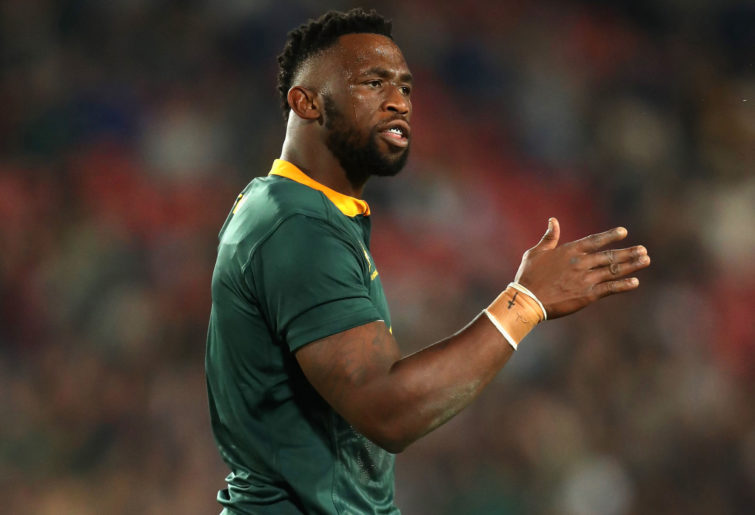
(Photo by David Rogers/Getty Images)
Kolisi had complained on Friday that he hadn’t been shown due respect by last week’s referee, Nic Berry. He’s a World Cup-winning captain. He knows better than anybody that the way to earn respect is by doing exactly what he did; saving tries, carrying strongly and wrestling manfully at the breakdown.
The press conference, calculated to open the door to accusations of implied racism against Berry, was not Kolisi’s finest hour. But this may have been his best Test as a Springbok.
At halftime, the Lions must have felt that everything was on track, unfolding just as it had last week. But in the championship quarter, where the Springboks found another gear, the Lions engine began to splutter and misfire.
Adopting a strategy of playing in the air is only as good as the ability to secure the contestable ball. Haring forward, the Lions runners began knocking the ball forward in the contest, or slapping it as far back as from where it had been kicked. And receipt of the Springboks’ kicks increasingly became a lottery.
In a word, what the Lions lost was control. With the weight of possession turning against them, the penalties started to flow the same way, and captain Alan-Wyn Jones began asking questions of referee Ben O’Keeffe he already knew the answer to.
Whatever the nonsense that will be written and talked this week – and we all know there will be plenty – one truth is that it is now Warren Gatland who is under extreme pressure, having to decide on the personnel and tactics to win.
Short of options and time, Gatland’s pragmatic nature will ensure that there will be no radical, high risk approach. That’s a strategy that would almost guarantee the ball being jolted free somewhere way behind the advantage line, for Mapimpi, Am or Cheslin Kolbe to streak away.
Better handling alone will be enough to have the Lions right in the contest. But can they squeeze an extra ten percent out of their scrum? Or manufacture a wee bit of fractured play to bring Anthony Watson and Stuart Hogg into the game? Easier said than done.
With such a ridiculous amount of focus being placed on the match officials, O’Keeffe will be delighted how, just like Berry the week before, his performance had no bearing on the result. He was calm and assured throughout, and despite the players often showing a desire to act like school bullies, there was never doubt as to who was in charge.
The only time O’Keeffe’s knees buckled was in the awarding of Am’s try. In real time, it looked like Am scored, on replay it looked like Am scored, yet O’Keeffe kept asking for more angles.
That was only asking for trouble, as was his extended explanation to the players afterwards; just as he had done after deciding on a yellow card for Kolbe. Clear communication with players is always a good thing, but sometimes the best thing to do is to simply make the call and move the game along.
What this tells us is that, no matter how competent a referee is, the pressure of a Lions series is at another level altogether. The decision Romain Poite got wrong in 2017’s final Lions Test against the All Blacks was not whether Ken Owens was offside or accidentally offside, but to be gripped by the high stakes of the moment and call in his TMO, and cede control of the situation.
Single moments are elevated to such a level that officials, in their effort to get things right and not become the story, sacrifice the very attributes that got them to the top of their profession in the first place; feel for the game and application of common sense.
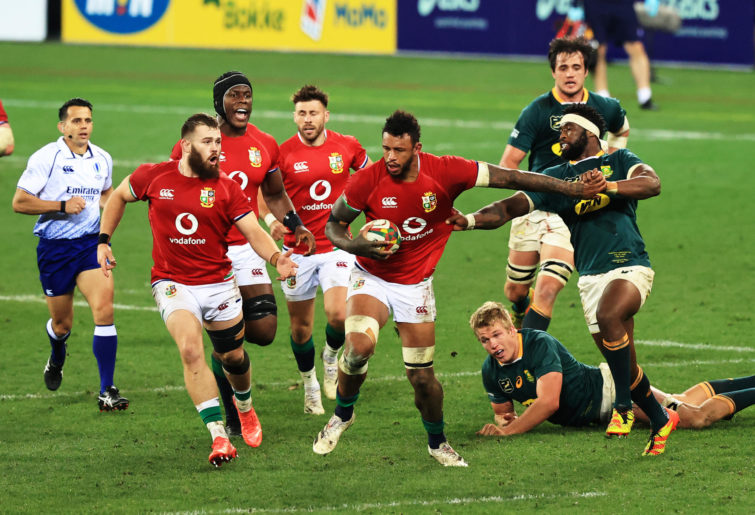
(Photo by David Rogers/Getty Images)
Usually, a lot of that pressure is generated by the media, but in this case the catalyst – or should we say, culprit – was South Africa’s Rassie Erasmus.
The contents of his hour-long video targeting Berry don’t bear repeating here, but the implications may well represent a critical juncture for rugby.
Let’s be clear, Erasmus was not accusing anyone of racism. It isn’t even clear that Erasmus genuinely believes half of what he claimed. His sole intention was to spark a bush fire – by any means – to take media attention away from the failings of the first Test, keep coach Nienaber out of the spotlight, and to galvanise fans behind a ‘victimised’ team.
There can be no argument that he succeeded. And whether the Springboks finding their rhythm in the second half is down to Erasmus’ grandstanding or not, 27-9 is the only measurement that matters.
Or is it? Erasmus may not care what the rest of the world thinks about his actions, and that the ends justify the means. If he and Kolisi are happy to burn the goodwill and capital generated by the World Cup win, that’s their business.
But rugby is bigger than the self-interest of any coach, captain, director of rugby or waterboy. A central tenet of the sport, taught from the earliest age, is to show respect for the referee. No raising of the stakes, no World Cup final, no Lions tour, should ever undermine that principle or excuse any violation of it.
That the abuse of Berry is less about Berry’s failings as a referee than it is a convenient device to pursue another agenda, does not mitigate the action. It makes it worse.
It is to be hoped that the only reason World Rugby has yet to address the matter is because the last thing this series needs is more controversy. But come this time next week, win, lose or draw, Erasmus must be called to account for his actions, and heavily sanctioned.
Anything less risks a little piece of the soul of the sport being cut adrift, and reinforces a message that it is now ok to play the man and not the ball. It isn’t.
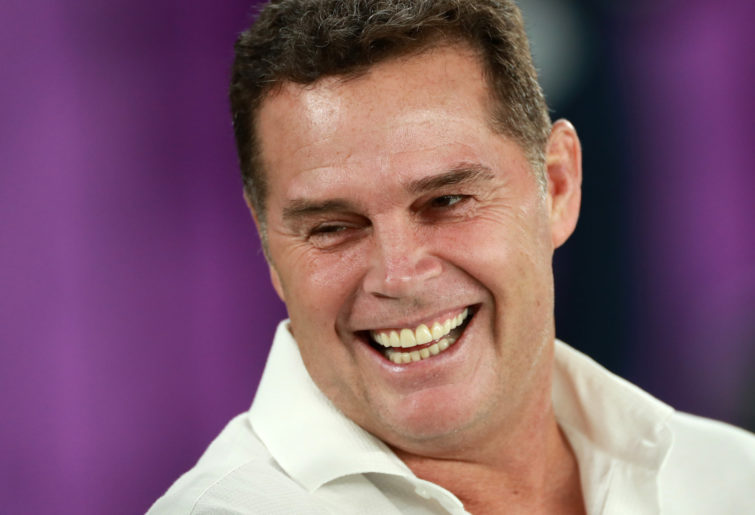
Rassie may have had the last laugh. (Photo by David Rogers/Getty Images)
Despite the absence of one of the things that makes sevens rugby what it is – a noisy, pulsating crowd – the Olympic Games delivered in spades, in both the men’s and women’s divisions.
A gold medal won’t improve health or economic outcomes in covid-ravaged Fiji, however the symbolism behind their men’s victory, as it was in Rio, cannot be overstated. The quality of their play, too, entirely admirable.
Women’s winner New Zealand had their shaky moments, but saved their best for the final, shutting down a high-quality French team, and in the process, going one better than their Rio silver. But anyone wondering what to do with some spare cash might want to get on early for 2024; Fiji to complete the men’s and women’s double.
The tournament highlight however, came with Argentina eliminating the more highly fancied South Africa, en-route to a bronze medal.
Anyone who has played sevens knows what excruciatingly hard work it is. Covering a rugby pitch with just seven men requires the engine of a 747 and the heart of Phar Lap. Playing eleven of fourteen minutes with six men, and the final, tense play with just five, takes things into the realm of the ridiculous.
Sports opinion delivered daily
In the Argentinian way, tears were shed; from the players on the pitch, from the injured comrades, and from the banished. It was a timely reminder that the very best of sport doesn’t always need crowds; it just needs skilled, committed athletes who are prepared to give their all for the cause.
Both Australian teams had their moments, but when a side like Fiji can afford to sit human wrecking ball Semi Radradra on the bench, the message is clear. By comparison to the other leading sides, men and women, Australia lacked players with size, power, pace and athletic ability.
Whoever picks up the reins for Australian sevens from here is faced with a substantial recruitment challenge.
Original source: https://www.theroar.com.au/2021/08/02/the-wrap-springboks-victory-surge-vindicates-erasmus-but-at-what-cost/
https://therugbystore.com.au/the-wrap-springboks-victory-surge-vindicates-erasmus-but-at-what-cost/
Original source: https://www.bbc.co.uk/sport/rugby-union/58051015
Original source: https://www.bbc.co.uk/sport/rugby-union/58041234
The British and Irish Lions have lost 27-9 to South Africa in the second Test in Cape Town, with the three-match series now level at 1-1.
South Africa backs Makazole Mapimpi and Lukhanyo Am have scored second-half tries as the Springboks beat the British and Irish Lions 27-9 to win the second Test at the Cape Town Stadium and level the series.
Handre Pollard added five penalties and a conversion for a 17-point contribution while the Lions points all came off the boot of Dan Biggar in a niggly and ill-tempered contest on Saturday that was again one for the purists rather than the enthusiast.
The result sets up a decider next Saturday after the Lions had won an attritional first Test 22-17.
The Lions were 9-6 up at halftime but the Springboks bounced back with a dominant second-half performance.
They scored 21 unanswered points in the second period, a reversal from the first Test when it was the Lions who roared to the win with forward dominance after halftime.
“That was special, it was what we needed,” South Africa captain Siya Kolisi said. “It has been a tough week. For me, personally, as a leader it has been the toughest week I have had to face.
“But I’m thankful for the coaches who made us focus on the mistakes we made in the first Test. Our maul and scrum was much better this week.
“I’m grateful we stood up to the challenge, that is how I know us as a team.”
The Lions were clearly fired up from the start, led by captain Alun Wyn Jones, as they piled into tackles and beat the Boks back, but it was the home side who took the lead from an early penalty.
Biggar then slotted two penalties to put the Lions in front before both sides were reduced to 14 players within a few minutes of each other.
First Duhan van der Merwe received a yellow card for a cynical kick at the shins of Bok wing Cheslin Kolbe before the latter was also sent to the sin-bin when he upended Lions scrumhalf Conor Murray in the air.
It was a contentious moment that could have seen him given a red card, but he was perhaps saved by the fact he had his eyes on the ball all the way and there was a lack of malicious intent.
South Africa levelled through a Pollard penalty just past the half-hour mark, but Biggar added to his tally and the Lions led 9-6 at the break.
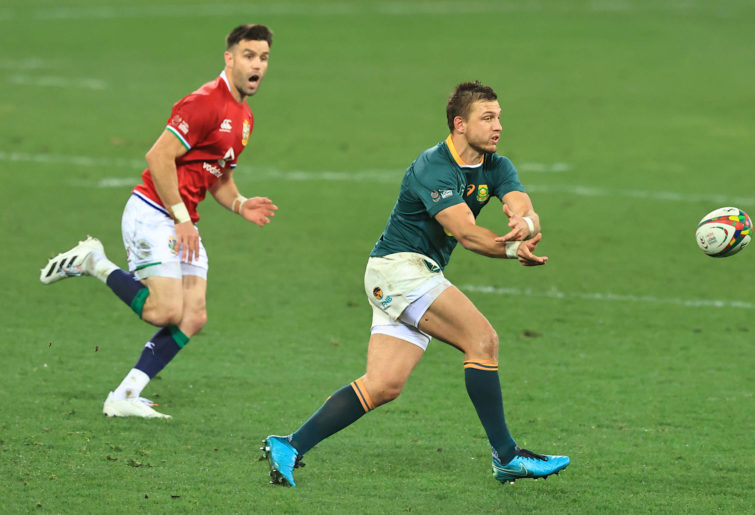
Handre Pollard of South Africa Springboks passes the ball. (Photo by David Rogers/Getty Images)
The Boks, crucially, struck first in the second period when they swarmed into the Lions 22, and Pollard’s cross-kick was collected by Mapimpi on the right wing and he was able to score the first try of the game.
Both teams emptied their benches onto the pitch just before the hour mark, and it was the Boks who came out the stronger.
They drove a maul a full 25 metres into the Lions’ 22, scrumhalf Faf de Klerk’s clever grubber kick was pounced on by Am just before it went over the dead-ball line and the home side led by nine points.
They continued to force the Lions into errors at the breakdown and set-piece, and Pollard extended the lead with his boot.
“The momentum shift was like last week, but this time in South Africa’s favour,” Lions captain Jones said.
“We came off second-best in the breakdown and aerial battle in the second half.
“They had the ascendancy with their maul game and we have plenty to work on.”
Original source: https://www.theroar.com.au/2021/08/01/the-springboks-handle-the-british-and-irish-lions-27-9-to-level-the-series/
