Friday, April 23, 2021

Why Australia needs a professional rugby sevens comp

With the COVID-19 pandemic predictably making the World Rugby Sevens Series an impossibility in 2020, fans longing for the thrill-a-minute excitement and laid-back, party atmosphere of the touring series have been forced to curb their enthusiasm until the 26th of July when the world’s best begin their battle for gold at the rescheduled Tokyo Olympics.

The shortened version of the 15-a-side game will feature for the second time following the code’s 92-year hiatus from the global sporting event.

The marketing potential of the seven-a-side format has long been noted. HSBC’s 2016 report The Future of Rugby found it the fastest-growing sport in the world and with its inclusion in the Olympics attracting an estimated 30 million fans, it has proven to be a valuable instrument in rugby’s bid to win over new supporters. The carnival-style tournament can draw in fans who might otherwise fall outside of rugby’s traditional demographic with loud music, audacious attire and wall-to-wall action.

Australia found itself experiencing a significant boost in participation following the national women’s sevens side claiming gold at the Rio 2016 Olympics. Off the back of their success rugby union saw its first increase in total participation nationwide since 2012, with national primary school program Game On jumping in participation from 9900 to 39000. That particular program catering to 60 per cent public schools, an area rugby has traditionally struggled to engage.

Speaking to the ABC in 2016, then Australian Rugby (RA) participation growth manager Cameron Tradell talked on the potential of rugby sevens to replicate the resurgence of Australian cricket through the Twenty20 Big Bash League, “Sevens has the same explosiveness around what is happening on the field, and the expectation of the unknown when you head to a sevens game is very similar to the BBL,” Tradell said.

“I think the fact it is genuinely seen as being an equal opportunity game because of the success of the girls puts us in a stronger position than cricket with regards to having so much opportunity to showcase the nuances between the male and the female game.”
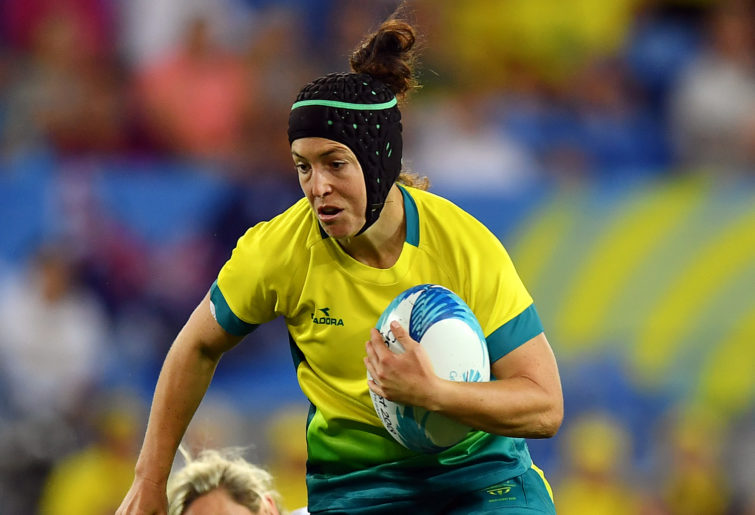
Emilee-Cherry-755x515.jpg

Emilee Cherry of Australia. (Photo by Dan Mullan/Getty Images)

Given Tradell’s words and the building anticipation around the next Olympic appearance, one begins to wonder why moves have not been made to introduce a professional national rugby sevens competition.

The introduction of the AON sevens in 2017 proved a step in the right direction. The four-tournament series successfully bringing together Australia’s best women in a ten-team competition featuring some of Australia’s top universities from almost every state and territory. The competition has provided a clear pathway for players seeking to earn a professional contract with Rugby Australia, strengthening the national player pool and provided a platform for national selectors to prospect talent.

Yet, there has been little mention of such an equivalent for men despite new broadcast partner the nine network signalling their interest. Surely with the proven growth and inherent marketability of rugby sevens, it must be time to start discussing how we can expand the game. Australia has the opportunity to pioneer a whole new market beyond the rugby crowd and reach out to would-be fans who may think of rugby as too boring or complicated and show them what our sport is really about.

With the backing of a willing broadcaster keen to show off their newest jewel and hopefully another successful Olympic campaign, now is the time to put the wheels in motion on a platform that will showcase our top rugby sevens talent on our screens and at our stadiums. The infrequent nature and geographical limitations of the World Sevens Series can no longer cater to the growing appetite for all-day action, costume coordination, day drinking and Sweet Caroline sing-alongs.

The option to play in summer makes the prospect all that much sweeter. Not only do the sunny days provide suitable conditions for a good time, they also present the opportunity to catch the hungry eyes of cross-code fans. The tournament setups lesser need for long-term commitment along with the emphases on entertainment and lower bar of law comprehension could help draw in those bored fans.

On top of helping rugby expand into the markets of other codes, sevens could also aid in rugby’s bid to win support outside of its traditional heartlands. A conquest that has proven difficult for Rugby Australia in recent years could be simplified with sevens’ lower requirement for talent depth and limited need for travel.

One could safely assume that providing a platform and exposure to players who might normally fall outside of the scope of elite rugby, like those outside of traditional heartlands and players on the fringes of rival codes, would translate to increased participation. Paving the pathway for the next Maurice Longbottom.

Rugby Australia, through the success of Super Rugby AU and despite the now-defunct status of the National Rugby Championship (NRC), have proven that they can, at least structurally, sustain a competitive national competition. Though little can be said for the marketability of the ladder, RA now with the backing and brains of the nine network media machine has the means to put together an enticing and potentially profitable product.

For too long Australia has treated rugby sevens as little more than a feeder to the 15-man code. Our national men’s side has suffered from chronic inconsistency, with top players being plucked away to train with Super Rugby sides, forcing the introduction of players with limited sevens experience.
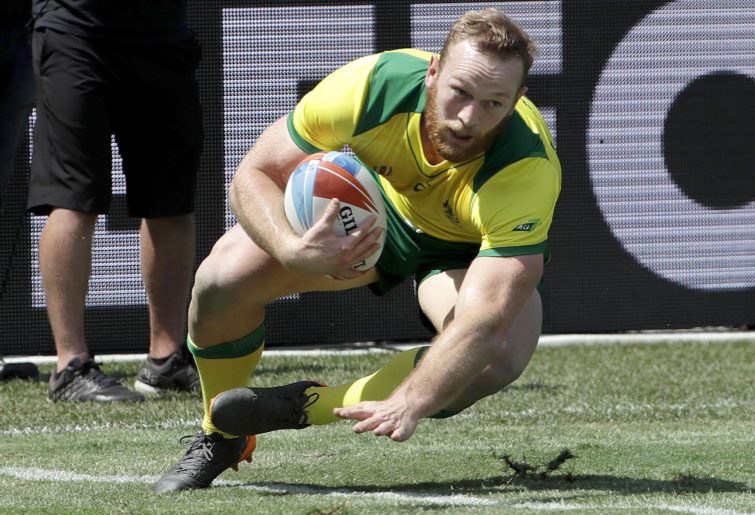
rugby-super-rugby-rebels-boyd-killingworth-755x515.jpg

Australia’s Boyd Killingworth. (AP Photo/Jeff Chiu)

While perhaps the proposed national club championships or any other such form of NRC replacement should, rightfully, be the priority. The potential reach of rugby sevens could very well put it on equal footing to the proposed state of union, Queensland vs New South Wales representative match up that some consider to be too contrived.

Even if the reality is a long way from now, we can continue to expose the public to the game of rugby sevens and all its chaotic glory. If a male equivalent to the AON Sevens is for whatever reason considered unfeasible, at the least a more coordinated front is needed to display the top domestic male sevens talent in Australia on a regular basis, keeping one eye on moving the operation to the next level.

We must wake up to the potential of rugby sevens and harness its growing power. While I understand that money may be tight at RA headquarters at present and I’m aware of the time and money necessary for a proposal like this, whether they roll the dice or play it steady, the rewards could prove to be numerous.

I’ll turn it over to you guys now. Let me know what you think of the idea and how it might look.

Original source: https://www.theroar.com.au/2021/04/23/why-australia-needs-a-professional-rugby-sevens-comp/

https://therugbystore.com.au/why-australia-needs-a-professional-rugby-sevens-comp/

Women's Six Nations final, England v France: Poppy Cleall to start in place of Sarah Hunter

Poppy Cleall will start at number eight for England's Women's Six Nations final against France on Saturday, pushing captain Sarah Hunter to the bench.

Original source: http://www.bbc.co.uk/sport/rugby-union/56842952

https://therugbystore.com.au/womens-six-nations-final-england-v-france-poppy-cleall-to-start-in-place-of-sarah-hunter/

Thursday, April 22, 2021

British and Irish Lions: Maro Itoje backed by Sam Warburton to captain 2021 side

England's Maro Itoje is backed to lead the British and Irish Lions against South Africa this summer by the man who captained the last two tours.

Original source: http://www.bbc.co.uk/sport/rugby-union/56832630

https://therugbystore.com.au/british-and-irish-lions-maro-itoje-backed-by-sam-warburton-to-captain-2021-side/

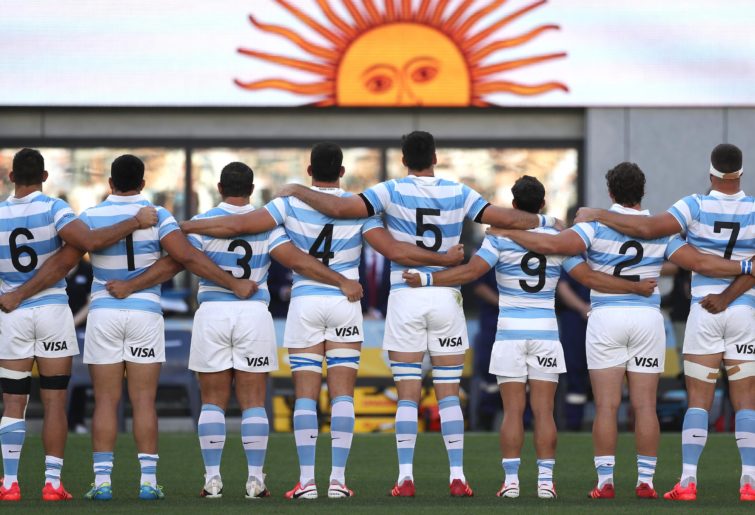
What South America can learn from Super Rugby

In 2015 Los Jaguares were the first professional Argentinian club team to join Super Rugby.

In their four short years they experienced a meteoric rise from 13th in their inaugural season to runners-up in their last. They were popular among fans and were welcomed by all.

In 2020 the fans could only watch as COVID-19 hammered the final nail into the Super Rugby coffin. Los Jaguares, lost and without an invite from the other SANZAAR nations, found themselves playing in the Super Liga Americana de Rugby (SLAR), replacing the Ceibos from Cordoba.

The South American competition ensures Los Jaguares are no longer the sole professional team on the continent. Los Jaguares now find themselves competing with the Cafeteros Pros from Colombia, the Cobras from Brazil, Olimpia Lions from Paraguay, Penarol in Uruguay and Selknam from Chile. The competition is the child of Sudamerica Rugby, which is hoping to expand and grow the game while giving the athletes a chance to become professionals in their home countries.

It’s an exciting time for rugby. Across the planet professional club teams are appearing. Growth seems inevitable. In a few short years we have seen the creation of SLAR, the expansion of Major League Rugby, the new Pacific involvement in Super Rugby and Japan’s restructuring away from corporate ownership in the Top League. There are even whispers of the Major League teams playing the SLAR teams to see who would be the champions of the Americas.

It seems rugby is growing. No longer is rugby enjoyed by only the historic powers of the northern and southern hemispheres.

rugby-union-pumas-755x515.jpg

(Photo by Mark Kolbe/Getty Images)

While growth is exciting, it can also be dangerous if not done carefully. Expand too quickly and limited funds are stretched too thin to be sustained. Expand to the wrong area and a support base can’t be built, which will further drain funds from the competition to keep a sinking team afloat.

Already the Super Liga is discussing expansion in their second season or when the COVID-19 pandemic subsides, with Spain, Portugal or Mexico being mentioned as candidates. More sensibly there have also been rumours circulating about a second Chilean, Uruguayan or Brazilian franchise. While this raises an eyebrow and some interest in the league, it would be wise for SLAR to learn some hard lessons from Los Jaguares and the fall of Super Rugby.

The first lesson SLAR should learn from Super Rugby is to not be spread thin. Too many teams across too many continents make for a competition too hard to follow week-in-week-out. For their own best interest the South Americans need to stay local and forget about the possibility of Spanish, Portuguese or Mexican franchises. Adding that trio would see nine teams in nine countries. The costs associated with and the impact on player welfare of flying across time zones would only strain the league. This does not mean that SLAR should forget them entirely, but rather it should use these countries to find talent for its own teams.

The second lesson is to be wary of a conference system. In its heyday Super Rugby followed a round robin format, but as it grew there needed to be a restructuring. There couldn’t be too many games due to the international calendar and there couldn’t be too few as broadcasters need games to make money. A four-conference system was introduced at Super Rugby’s peak of 18 teams. The complexity of figuring out which conference played which and who played who was a nightmare for fans to follow, creating disinterest in the competition.

Moreover, conferences allowed for some teams to have an easier draw of games. In 2017 the Lions won 14 of 15 games without playing any teams from New Zealand until the semi-finals. For the sake of the fans, keep it simple, keep it double-round robin and steer clear of the conference system.

Sports opinion delivered daily 


function edmWidgetSignupEvent() window.roarAnalytics.customEvent( category: 'EDM', action: 'EDM Signup', label: `Shortcode Widget`, );

The third lesson Super Rugby can teach SLAR is to start in the rugby heartlands. The first Super Rugby teams were based where rugby was the strongest in Australia, New Zealand and South Africa. If SLAR wants to increase the size of their league, then place the teams where the fans and academies are.

So where would be the best place to start expansion for the South Americans? Argentina is most obvious. After all, Los Pumas have been the envy of their neighbours for decades. Compared to the rest of the continent Argentina is a big fish in a small pond. There is no shortage of players either. The majority of the other teams have a good cluster of Argentineans to support their ranks. Despite the Olimpia Lions being based in Asuncion, Paraguay, the majority of players are Argentinian.

Due to Los Pumas success internationally, the majority of fans would also be based in Argentina. Already Los Jaguares are dominant in the competition and most likely to take home the trophy. A team in Cordoba, Rosario and Tucuman would be only beneficial and help to create some local derbies that would keep fans excited. A second team based in Buenos Aires would get the hot-blooded passion of South American fans pumping.

Look at the Primera Division of football, where there are multiple Buenos Aires teams. Often these games are the most hotly contested and watched on TV. The Superclasico between Boca Juniors and River Plate is renowned in the football world as a must-watch match every year. Imagine if the Jaguares had a local rival to battle each year. There is no shortage of talent in Buenos Aires either. Eight of the 16 teams that participate in the Nacional de Clubes, the national club competition, stem from the Buenos Aires area.

Excluding the Argentine superpower, where else should get an expansion team? For now there are only two other sensible choices.

Uruguay is the only other nation in South America that has also played at the Rugby World Cup. While Los Teros can only brag about winning three out of 15 World Cup games, a second Uruguayan team would help them to increase their developed player pool and help them to be more competitive. After all, most developed rugby nations have at least two professional clubs; Uruguay should be the same. However, this seems likely as Uruguay were touted as having two teams at SLAR’s creation.

Brazil could also have potential as a location for more teams. Brazil was originally supposed to have a second team based from Florianopolis before sensibly deciding it would be best to start with one team. The Maori All Blacks took on the Tupis in 2018 and have been competitive against teams like the USA and Canada. Not to mention that there is a market of 211 million people waiting to discover rugby in the football-mad country.

Expansion for the young league will inevitably happen, especially when there is an aim to grow rugby across the continent. For now we can only sit back, watch and hope that the Super Liga doesn’t follow the same footsteps as Super Rugby. After all, those who don’t learn from history are doomed to repeat it.

Original source: https://www.theroar.com.au/2021/04/22/what-south-america-can-learn-from-super-rugby/

https://therugbystore.com.au/what-south-america-can-learn-from-super-rugby/

Wednesday, April 21, 2021

Ten out of tens: What will Super Rugby Trans-Tasman deliver?

It is an exciting time for rugby in New Zealand and Australia.

A brand spanking new Trans-Tasman competition kicks off on May 14, with a quarantine-free air bridge underwriting it. That marks the beginning of a new era of co-operation between the two countries.

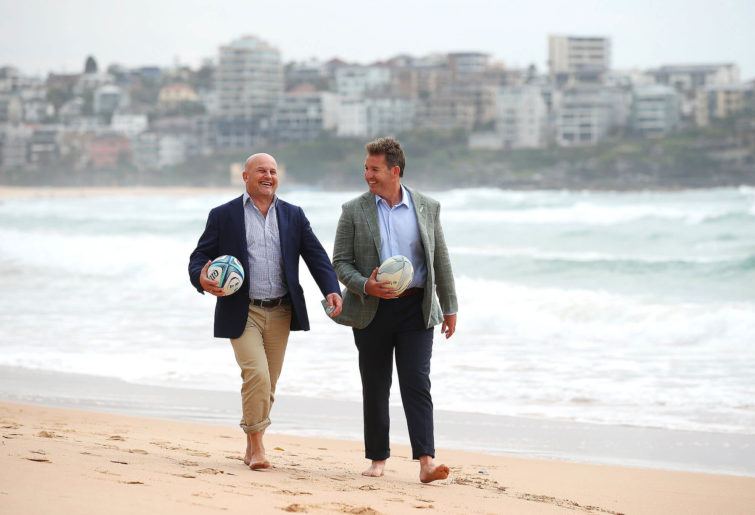
All the politicking and backbiting shed by the collapse of the old Super Rugby now seems to be just a dim memory, if the idyllic pictures of New Zealand Rugby CEO Mark Robinson and then-RA interim boss Rob Clarke walking together on Manly beach last November are to be believed.

rob-clarke-mark-robinson-755x515.jpg

(Photo by Cameron Spencer/Getty Images)

Super Rugby Trans-Tasman not only fills a yawning gap in the rugby calendars of both nations, it looks to offer a solid foundation for the future of the Antipodean game in the tier between provincial and Test rugby.

The recent announcement of the inclusion of two Pasifika teams in 2022 reinforces the sense that, at long last, something real and sustainable is happening in the administration of the game in the south.

When announcing the Trans-Tasman competition, Robinson was right to be delighted at the outcome.

“Super Rugby Trans-Tasman is a great result for fans on both sides of the Tasman and is testament to the strength of the relationship between New Zealand Rugby and Rugby Australia,” he said at the time.

“It has been a testing time for rugby in both countries, but also a chance to reimagine the game in our part of the world for 2021. The result is an exciting and innovative new competition, which will benefit fans, players, broadcasters and Super clubs.”

Clarke, who no longer sits in the top RA job, was similarly pleased.

“This is a truly historic day for rugby in the southern hemisphere, with the first-ever Australian and New Zealand Super Rugby competition.

“This will generate enormous excitement across both countries with some of the best players in the world set to challenge each other after the conclusion of Super Rugby AU and Super Rugby Aotearoa…

“I’d like to thank Mark Robinson and his team at New Zealand Rugby for working so closely with us. Bring on 2021!”

For Australia in particular, the existence of this stepping stone between domestic Super Rugby and international level is vital. The quality of the opposition will be consistently higher than it is in Super Rugby AU, and it will tell Dave Rennie far more about the Test-worthy aspirations of the players in his Wallabies squad. The coarse will be rapidly separated from the fine.

“We want to play the Kiwis and everyone wants to see it and we think it will bring the best out of us at all,” Queensland Reds captain James O’Connor said at last week’s Wallabies training camp.

“Everyone brings something different, like Australian rugby it’s similar styles but intricacies within that and the Kiwis are the same and I can’t wait to unlock their defence.

“We’ll watch some game footage, kick it old school, get the popcorn out and blackboard up and start writing some plays up, I’m really excited to do that.”

From this point of view, the May 22 tryst at Suncorp Stadium between the two current competition leaders, the Reds and the Crusaders, looms large in the calendar.

The Crusaders have some problems of their own. Although they still head up the Super Rugby Aotearoa table, they have lost two of their last three games and went down 25-26 to the Chiefs in Hamilton over the weekend.

Since I wrote a piece on the Chiefs at their most hapless in the middle of March, they have coincidentally won four games on the bounce to move within one game of the competition lead.

In that article and the discussion afterwards, I argued the case for moving Damian McKenzie to number ten and introducing Chase Tiatia at fullback.

The Chiefs started with that arrangement against the Crusaders, and with the added bonuses of a strong scrum and substantial contribution from the back row, the home side were able to dominate more than 60 per cent of territory and possession against the defending champions.

They made four times as many clean breaks, beat three times as many defenders, and made twice the number of offloads. The longer the game went on, the more control of the ball the Chiefs enjoyed.

With ‘D-Mac’ launching the high kicks off his right foot and Chase Tiatia booming a cannon off his left, the kicking game was in good hands:

But it was McKenzie’s ability to maintain constant pressure on the Crusaders defence with ball in hand that was the key to victory. I doubt any Australian number ten other than O’Connor, would have been able to match his level of decision-making, running and passing in the teeth of the defensive line.

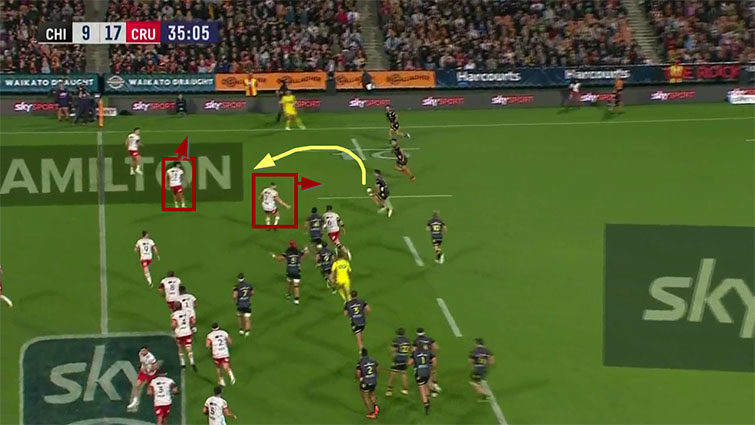
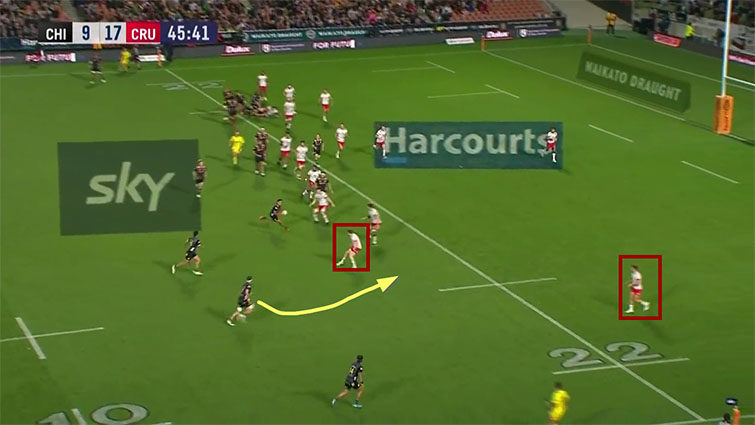
McKenzie varied his positioning intelligently according to the needs of the moment. In the following example, he has noticed an opportunity to exploit the Crusaders’ baffling selection of Tom Sanders – normally a blindside flanker – on the openside of the scrum:

Chiefs-rehab-1-755x425.jpg

The flyhalf gives himself five metres of depth off the pass from Brad Weber, in the knowledge that Anton Lienert-Brown is the man best placed to expose the transition zone between a forward (Sanders) and a back (number 13 Leicester Fainga’anuku). Sanders is facing forwards, Fainga’anuku is already looking towards touch. The extra depth allows him to get the ball into the critical space in comfort.

On the next phase, the scenario has changed completely. Against a defence still struggling to regroup and find structure after Lienert-Brown’s long break, McKenzie attacks the line much more aggressively, looking to make an extra pass in contact and prevent the opposition from reorganising:

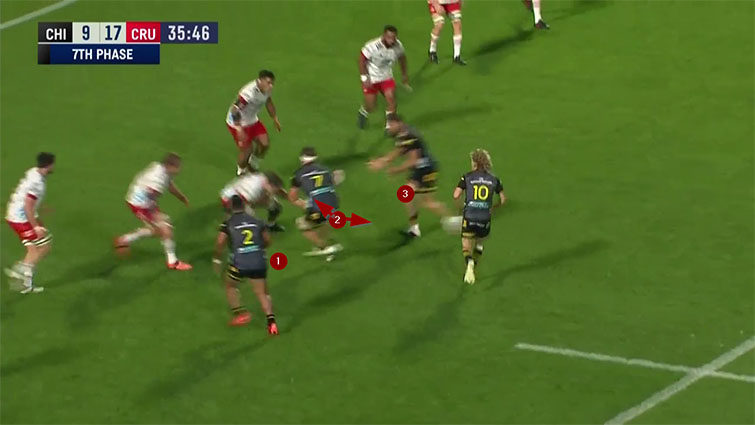
He delivers the offload to the Chiefs’ number eight Luke Jacobson. There was a positive connection between McKenzie and his back-row forwards – and Jacobson in particular – throughout the game:

Chiefs-rehab-2-755x425.jpg

McKenzie is ghosting no more than a metre or so behind the middle man of the forward pod in front of him (number seven Lachlan Boshier), ready to take on the Crusaders forwards opposite. Bryn Gatland would probably be standing a metre or two further back.

Jacobson made a living running off flat cut-out deliveries from McKenzie:

McKenzie only fires out the pass when he sees the defenders have been forced to stop and square up on him. That cuts downs their ability to react to any late changes of angle by Jacobson.

Put it all together, and intelligent hole-running from the back-row was able to convert the opportunities created by McKenzie and Tiatia:

Chiefs-rehab-3-755x425.jpg

After a long break by Alex Nankivell, McKenzie again drops off deep when he sees a gap developing between the two Crusaders edge defenders, number 22 Dallas MacLeod and number 11 George Bridge.

McKenzie does not overplay his hand, but prompts Tiatia to do most of the work at second receiver and release Boshier through the hole. On the following phase, he is right up at the line and comes close to scoring near the right corner.

In the final example, the same structure is divided into two consecutive phases:

First McKenzie leads Tiatia through the hole with another flat cut-out pass, then Luke Jacobson is up on next phase, dropping an offload to left wing Etene Nanai-Seturo.

The pressure on the Crusaders defence never slackened. It pushed the Chiefs over the edge and into playoff contention, and it may well have projected Damian McKenzie into the All Blacks squad as a first-five.

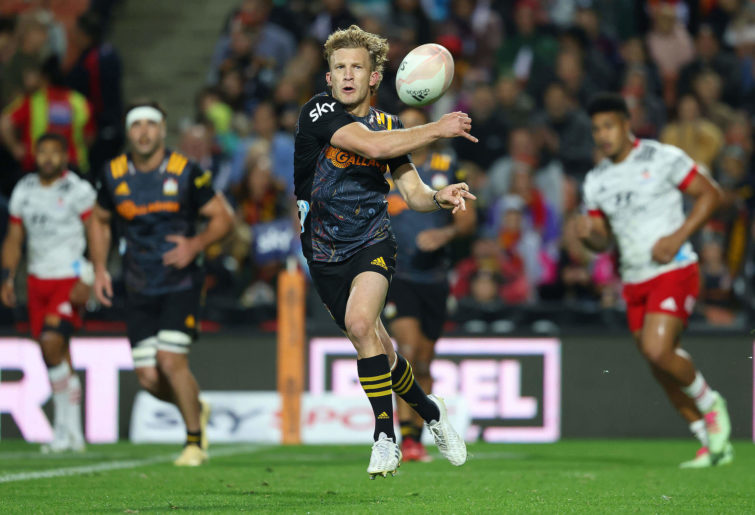
damian-mckenzie-passes-755x515.jpg

Damian McKenzie. (Photo by Michael Bradley/Getty Images)

Summary
For once, it was Richie Mo’unga’s turn to lurk in the shadows. Inevitably he had one moment of magic, setting up a first-half try for Will Jordan. But with his forwards dominating possession of the ball, it was Damian McKenzie’s time to hog the limelight at flyhalf.

And shine he did, with the help of Chase Tiatia at fullback and a workaholic back-row in which Luke Jacobson and Lachlan Boshier were outstanding. The Crusaders were second-best in most of the areas they are accustomed to dominating – the scrum, in contact, and in game management from the primary playmaking positions.

The Chiefs are unrecognizable from the rabble that lost 16-39 to the same opponents in the reverse fixture earlier in the season, and the game will have done McKenzie’s claims to be considered at first five-eighth for the All Blacks no harm at all.

The level of performance at which players like McKenzie and Mo’unga habitually operate will set the bar for their Australian counterparts when Super Rugby Trans-Tasman (hopefully) begins in mid-May.

An ancient rivalry is about to be renewed, and it will only gain in strength in 2022 from the addition of two more Pasifika franchises. Forget the Super Rugby AU final, it’s that first long look into the eyes of the auld enemy from across the water that really matters. Drink it up, because that’s the good stuff.

Original source: https://www.theroar.com.au/2021/04/21/ten-out-of-tens-what-will-super-rugby-trans-tasman-deliver/

https://therugbystore.com.au/ten-out-of-tens-what-will-super-rugby-trans-tasman-deliver/

Eddie Jones: England coach gets RFU backing after review

Eddie Jones is backed to continue as England head coach after a review into the team's disappointing fifth-place finish in the Six Nations.

Original source: http://www.bbc.co.uk/sport/rugby-union/56819737

https://therugbystore.com.au/eddie-jones-england-coach-gets-rfu-backing-after-review/

Tuesday, April 20, 2021

Why have SANZAAR remained silent on 2022 Super Rugby plans?

Though the two-way travel bubble is now officially open between Australia and New Zealand, we’re still a few weeks away from Super Rugby Trans-Tasman beginning in earnest, and to some extent this competition remains firmly in the ‘I’ll believe it when I see them running out” category.

Even just four weeks out from the first round of the competition, it feels like the prefix ‘proposed’ is still required.

There are far fewer reasons for it not to go ahead now, yet it still feels like it wouldn’t take much for it to be quickly to swept into the too-hard basket.

As we know, the proposed Super Round, originally pencilled in for Round 3 of the cross-over competition, already resides in said basket, after the game simply ran out of time to get such a mammoth event up.

But despite the fluidity that still sits around what professional rugby on either side of the Tasman looks like in just a month’s time, plans for next year are surging ahead regardless.

New Zealand Rugby took great delight last week in trumpeting its conditional approval for the addition of both Moana Pasifika and the Fijian Drua to next year’s competition.

“The NZR Board’s decision to approve licences is a major step toward the two Pasifika teams joining NZR’s existing five Super Rugby Aotearoa clubs and Rugby Australia’s (RA) five Super Rugby AU teams in a new tournament being planned for 2022 and is conditional on their final business plans and RA’s support,” the NZR statement read last Wednesday.

It was news greeted with great excitement across the various media, invoking plenty of discussion on social media and online forums, including these very pages.

Even with the significant and obvious ‘conditions apply’ fine print that came with the news, it is genuinely great news to see actual movement – rather than rhetoric – around granting access to the professional level of the game for the island nations of the Pacific.

Rugby Australia followed with a cautiously worded statement later the same day, indicating they were “encouraged by the announcement today regarding the conditional approval of licences to Moana Pasifika and Fijian Drua”.

“As joint participants and administrators in the competition, Rugby Australia looks forward to understanding the outcomes of the next phase in their licence approval,” the statement continued.

The key point for me, among several key points the RA response made, was the words, “As joint participants and administrators in the competition”.

Up until this point, you could easily have assumed NZR rugby were ploughing ahead regardless with plans and announcements for a competition on unknown structure, format, and administration. It wasn’t that far removed from their brinkmanship in the very early discussions around a post-COVID return, where they boldly made room for “two to four teams from Australia” in 2021.

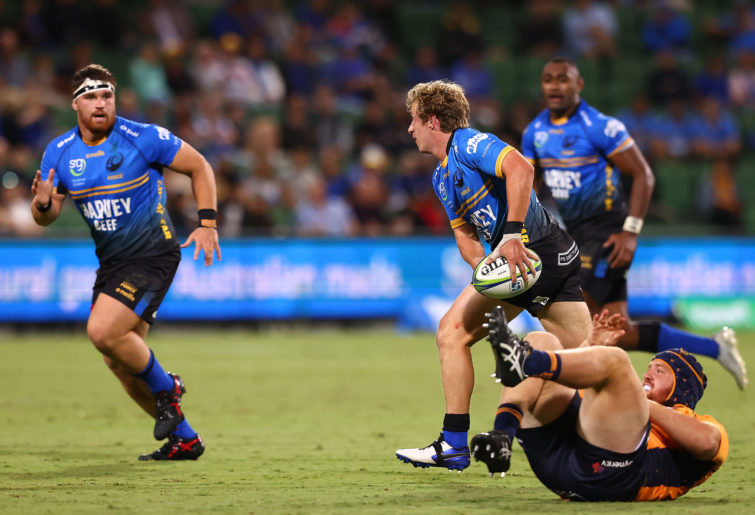
Jake-McIntyre-Western-Force-755x515.jpg

(Photo by Paul Kane/Getty Images)

But after eventually moving on from trying to work out what licences NZR were conditionally granting, my curiosity extended a bit further up the rugby tree – to the body who still, in theory, govern professional rugby in the southern hemisphere.

As more and more was being said and written and discussed about next year’s competition across the weekend, one significant question remained front of mind:

Why haven’t SANZAAR said anything about the plans for 2021?

Well, mainly because they’re not SANZAAR’s plans to say anything about, I’ve learned over the last day or two.

Whereas it had previously been explained to me that Super Rugby AU and Super Rugby Aotearoa, and even the upcoming Super Rugby Trans-Tasman remained SANZAAR competitions overseen by the joint venture governing body, this isn’t actually the case.

A SANZAAR spokesperson confirmed to me that the respective domestic competitions are owned by the national unions, and not the SANZAAR partnership; that is, the full joint venture including South Africa and Argentina.

Further, the upcoming trans-Tasman comp will be a joint venture of RA and NZR, with no oversight from SANZAAR.

SANZAAR’s role in the current competitions is more around assistance with travel and logistics management, and the judicial process. SANZAAR do announce match officials for the respective competitions each week, but the appointments are actually made by RA and NZR.

The SANZAAR joint venture owns and runs The Rugby Championship tournament, a la the Six Nations, but now does not oversee a provincial tournament within its remit.

The Super Rugby brand remains SANZAAR’s, and its attachment to the domestic comps in Australia and New Zealand makes perfect sense, as it did with Super Rugby Unlocked in South Africa late last year. Whether the Super Rugby name remains in place next year, and how that competition is governed remains a decision for RA and NZR.

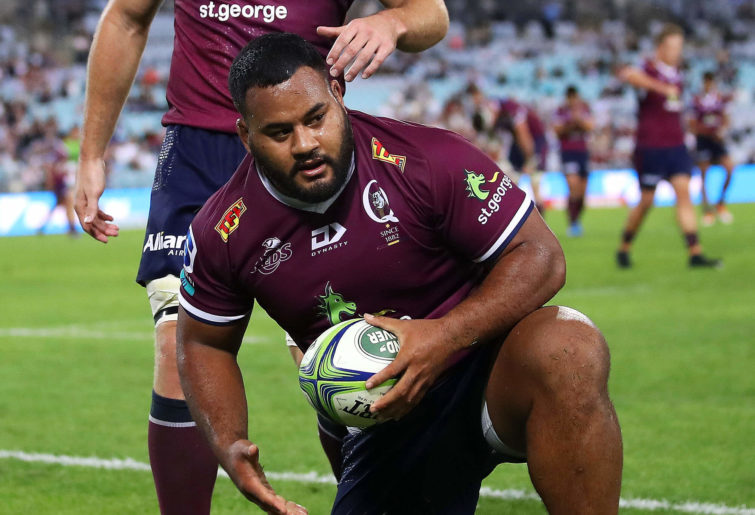
taniela-tupou-after-scoring-a-try-755x515.jpg

Taniela Tupou. (Photo by Mark Kolbe/Getty Images)

So, what of Rugby Australia?

Their involvement so far has – by design – been to let NZR run whatever process they feel needs to be run, but comfortable into the knowledge they will still be able to make the best decision for Australian rugby.

Reporting over the weekend confirms this, as does last week’s statement: “Rugby Australia is excited about the growth of Rugby in the Pacific and is committed to exploring future opportunities in the region, in conjunction with the continued sustainability and success of Australian Rugby and its Super Rugby teams.”

My understanding is conversations between Australia and the Fijian Rugby Union have been going on for months, and that discussions about the Drua entering Super Rugby were firmly on the table, even if it just meant the Australian edition again. Australian rugby has reasonable runs on the board regarding assisting the game in Fiji, but there’s also no denying three games a weekend is better than two.

Equally, and logically, six games a weekend is also much better than four.

It’s my understanding that RA have given themselves a timeframe of the next few months to conduct their own due diligence on the bids, and to make sure they are confident both teams will be ready to go in 2022. Paul Cully for Stuff.co.nz wrote of this too, that delaying to 2023 could be an option “if (RA) feel the process has been rushed or would compromise the launch of the new competition in 2022.”

That said, if the bids do stack up for RA, then the next step in the process would be to enter discussions with NZR around competition format (e.g., a round robin or conferences), and how the competition is running. Again, both RA and NZR have raised the topic of a commission style governance.

It’s all really encouraging.

No doubt, the news around Moana Pasifika and the Fijian Drua edging one step closer to the professional game is wonderful, and is rightly being celebrated for being the wonderful opportunity that it presents.

And I say that even with all of the obvious and complicated questions that remain. Lots of very important details still need to be worked out, even once further approvals are given and Rugby Australia provides its own rubber stamp on the process.

Clearly, there’s a lot of boxes to tick. But it certainly feels like there is enough good will on all sides of the 2022 plans to get it done.

Original source: https://www.theroar.com.au/2021/04/20/why-have-sanzaar-remained-silent-on-2022-super-rugby-plans/

https://therugbystore.com.au/why-have-sanzaar-remained-silent-on-2022-super-rugby-plans/